July 28, 2026
Studying Fashion Design? Why You Should Learn to Sew
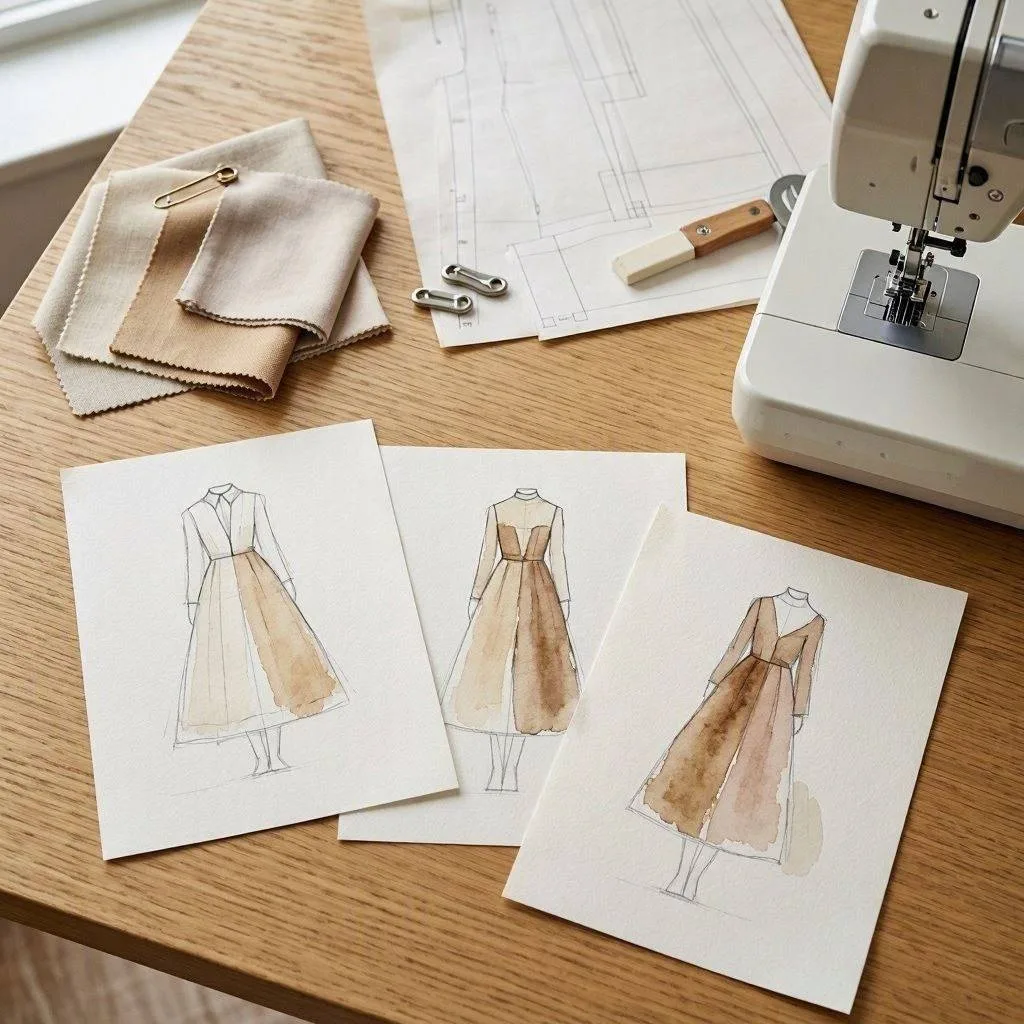
A woman came to me last spring with a folder of drawings. Really good drawings: dresses in watercolour, fabric swatches pinned to the corners, little notes about buttons and hemlines. She had studied fashion design for a full year. And in all that time she had never once sat down at a sewing machine.
Not once. She could render a gown beautifully, but she couldn't tell me how the side seam would sit on a real body, or whether the collar she'd drawn would hold its shape in the cotton she had in mind. That gap is what I want to talk about, because among the women I meet studying fashion design in Abu Dhabi, she is far from alone.
A year of sketches, a machine she'd never touched
Design programmes teach plenty: history of costume, illustration, mood boards, colour, trend research. All of it useful. But some of them let you reach a diploma without ever building a garment with your own hands. You leave able to draw a dress, without knowing how a dress is actually held together.
My student knew the names of things. She just didn't know how they behaved. She had drawn a soft, deep cowl at the neckline and chosen a crisp cotton poplin to make it. On paper it looked lovely. In that fabric it would have stood out like a paper bag. Nobody had told her, because you learn that from cloth folding over your hand, not from a textbook.
What sewing teaches a designer that drawing can't
When you learn to sew, things fall into place that no illustration class reaches:
- Garment construction. A dress is built from flat pieces: darts, seams and facings, assembled in a set order. Once you've put a bodice together yourself, you draw seam lines that can actually be sewn.
- How fabric behaves. The same design in poplin, in silk, and in jersey is three different garments. You only feel that with cloth in your hands.
- Real fit. On paper every figure is tall and symmetric. Real shoulders slope, real waists sit at different heights. Sewing on a living body shows you where a seam pulls.
- What can and can't be made. Some lovely sketches simply won't hold in fabric. Knowing that before you commit saves money and disappointment.
None of this makes the drawing less important. It makes the drawing honest. You keep the imagination, and you add the part that tells you which ideas will stand up.
How it protects you with a factory or contractor
This matters most if you want your own clothing brand. Very few designers sew their own production. They write a brief and hand it to a contractor or a small factory, and the quality of that brief decides almost everything that comes back.
My student had already tried this once, before she found me. She had paid a workshop for a sample. It came back wrong: the fit was off, the finishing was cheap, and she couldn't say why. Was it the contractor, or her own instructions? She had no way to tell, so she paid again for a second attempt.
Once you understand garment construction, that stops happening. You can:
- Write a brief they can follow. Fabric weight, seam types, where to interface, how the hem is finished, how much ease to leave. Specifics, not adjectives.
- Check what comes back. You can see a puckered seam, a lining that pulls, an interfacing that's too stiff, and put a name to it.
- Judge the price. When you know roughly how long a piece takes to cut and sew, you know whether a quote is fair or whether someone is charging you for air.
A contractor deals differently with a designer who understands construction. When your brief is precise, there's far less room for overcharging or quiet corner-cutting.
What to learn first, if your time is short
You don't need years at the machine for this. A design student's time is usually tight, so if I had to choose what comes first, it would be these:
- Threading the machine and sewing a straight, even seam. The foundation of everything.
- Darts and simple seams, so shaping stops being a mystery.
- Setting in a zipper and finishing a hem cleanly.
- Pressing. It sounds dull. It's half of what makes a garment look professional.
- Reading a simple pattern and sewing one real garment from cut to finish.
That much already changes how you draw and how you talk to a factory. If you've genuinely never touched a machine, this is what a first lesson looks like, and it's less intimidating than you expect.
A format that fits a busy student or founder
I teach one-on-one, and we book by the hour, so it bends around a study timetable or a young business. There's no fixed package you have to finish by a certain date. We can spend one block purely on construction basics and leave it there if that's all you need.
For many people that base is plenty. Some go further: once you're sewing confidently and designing pieces of your own, that's the point where one-on-one mentorship makes sense, where we take your idea and carry it all the way to a finished garment. You can see the full path and the pricing on the sewing classes page.
If you can draw but you've never sewn, you're not behind. You're one skill away from understanding your own designs completely. Come sit at the machine, and we'll start there.
Read Also
From Student to Designer: What Sewing Mentorship Looks Like
After the courses end and you start designing your own pieces. What the next stage looks like.
I Want to Learn to Sew: Where to Start in Abu Dhabi
Five real fears people have before booking a first sewing lesson, with an honest answer to each one.
Sewing to Slow Down: A Screen-Free Way to Train Focus
Sewing gives your hands one clear job and your attention somewhere to rest. A calm, screen-free way to train focus, taught one-on-one in Abu Dhabi.