July 22, 2026
Sewing to Slow Down: A Screen-Free Way to Train Focus
A while back a woman came to her first lesson straight from work. She set her phone on the table face up, right next to the machine, and every minute or so her eyes flicked back to it. She told me later she'd nearly cancelled twice that day, because her head was too full to add one more thing. We threaded the machine anyway. I showed her how to feed the fabric, she started her first straight line, and somewhere around the hour mark she looked up and realised she hadn't touched the phone once. She seemed genuinely surprised. "That felt like a rest," she said, which isn't what most people expect from learning something new.
I hear a version of that a lot. People arrive tired and wired at the same time, and they leave calmer than they came in. So I want to talk about the side of sewing that has nothing to do with clothes: what it does for your attention.
Why sitting still and concentrating got so hard
It isn't only you. Most of us spend the day split across a dozen tabs, a phone that buzzes every few minutes, and a list that never quite empties. The mind gets used to jumping. Then you sit down to read a page or finish one small job, and it won't settle, because it's been trained all day to go looking for the next ping.
Your focus is a muscle, and screens keep it soft. Willpower doesn't really fix that. What helps is giving your hands one clear job and letting your eyes follow along, which is more or less what happens the moment you sit down at a sewing machine.
What happens when your hands are busy
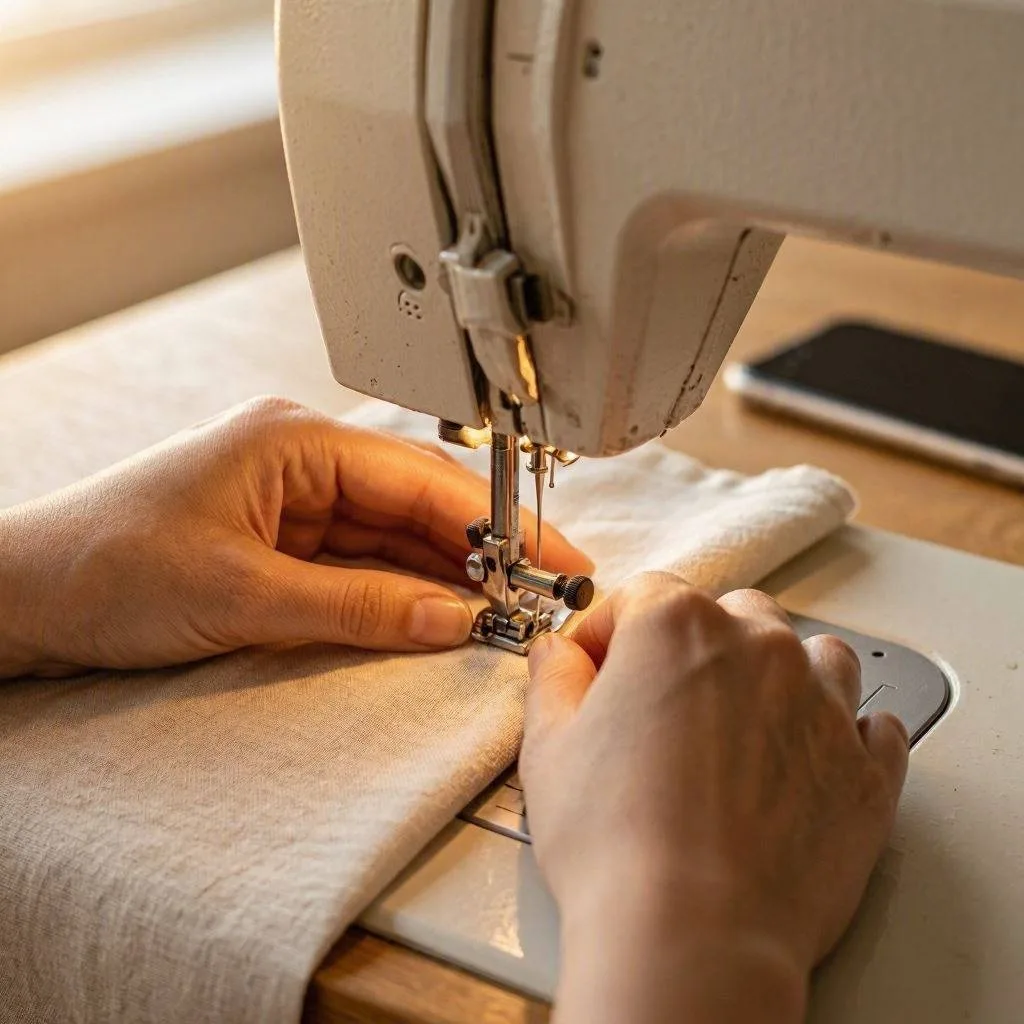
Sewing keeps both hands and both eyes working together. You guide the cloth with your fingers, you watch the needle, you hold the seam a steady distance from the edge, you hear the machine change its note when the fabric gets thicker. There's no spare channel left over to worry about tomorrow's meeting.
People call this flow. I just call it the thing that happens around ten minutes in, when a student goes quiet, leans forward a little, and the whole room settles with her. The task in front of you is small and it's real. Sew to the corner. Lift the foot, turn, line up the next edge. Your attention finally has somewhere to sit, so it stops circling.
It's a physical thing too, and that counts for more than people expect. You're touching cloth, pressing a warm seam flat, feeling the weight of something you made. A screen gives you nothing to hold. A needle and a length of linen give you plenty.
Why an hour of it feels like rest
Plenty of hobbies quietly turn into work. You track the run, you post the photo, you keep the streak alive. Sewing stays off that treadmill. No notification, no leaderboard, no app asking how you slept. It's you, a machine, and a piece of fabric slowly turning into something you can wear.
That's a big reason a screen-free hobby lands so well here in Abu Dhabi, where a lot of us already spend the working day in front of a monitor. An hour with the phone in another room is a genuine break, and you walk away with a finished cushion cover or a sleeve set in, instead of a stiff neck and a fresh pile of half-read emails.
"But I get distracted so easily"
This is the worry I hear most, and often from the very people who end up loving it. If your attention likes to wander, a task that keeps tugging it back every few seconds can be easier than sitting in silence, ordering yourself to concentrate. The machine gives you steady feedback. Go too fast and the line wobbles. Drift off and the crooked seam tells you straight away. You get pulled back without having to force it.
Some of my students have told me they have ADHD, and that an hour at the machine is one of the few stretches where their head actually goes quiet. I'm a tailor, not a doctor, so I won't make any claims about that. I can only tell you what they say, and what I watch happen: someone who couldn't sit still at the start of the lesson, absorbed and steady by the end. If that sounds like something you're short on, it's worth trying.
How to try it without any pressure
You don't have to commit to a course or buy a single thing. The easiest way in is one lesson, just to see how it feels in your hands. If you're not sure where to begin, I wrote a longer guide on how to start sewing in Abu Dhabi that walks through the usual worries.
We can work in my studio, or I can come to you: I bring the machine and everything with it, so a clean table is really all you need. I compare the two in studio versus home lessons if you'd like to weigh them up. Either way it's a calm, women-only space, and we go at whatever pace suits you, with nobody leaning over your shoulder.
When you're ready, you can look over the full sewing classes and prices. Beginners are welcome, and honestly they're most of who I teach.
You don't need to dream of making your own wardrobe for this to be worth it. Some days the best reason to sew is simply an hour where your hands are full and your head is quiet. If that's what you're after, come and sit down at the machine.
Read Also
I Want to Learn to Sew: Where to Start in Abu Dhabi
Five real fears people have before booking a first sewing lesson, with an honest answer to each one.
Sewing Classes in Abu Dhabi: Studio or Home Service?
The most common question after "how much": "do I come to you, or can you come to me?". Both work well; here's how to choose.
Studying Fashion Design? Why You Should Learn to Sew
Studied fashion design but never touched a machine? Sewing shows you what can actually be made and what can't, and how to brief a factory. Hands-on classes in Abu Dhabi.