September 5, 2026
Pattern Drafting in Abu Dhabi: The End of Almost Fitting
There is a moment that arrives for almost every student who keeps sewing. She finishes something, puts it on, and it is good. Neat seams, right fabric, the thing she planned. And it almost fits.
The shoulder line sits a centimetre off. The waist lands slightly high. The sleeve pulls when she reaches forward. Nothing is wrong enough to name, and the whole garment is a little bit not hers.
That is not a sewing problem. No amount of better stitching fixes it, and it is worth knowing why.
What a bought pattern actually is
A commercial pattern is one shape, drafted once for an averaged body, then scaled up and down into a size range. That average was assembled from measurements of many women, which means it describes none of them.
So every adjustment you make afterwards is a negotiation with someone else's assumptions. You let out here, take in there, and shift the shoulder seam, and what you are really doing is arguing with a shape that was never built around you.
Some bodies are close enough to the average that the argument is short. Most are not.
What drafting is instead
You start from your own numbers.
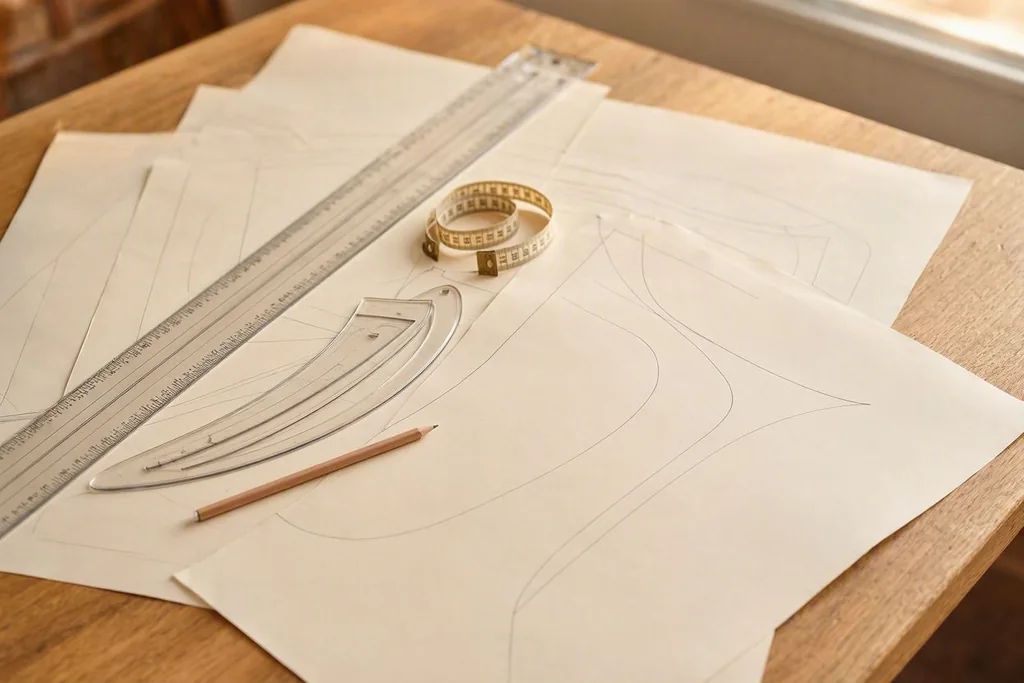
Pattern drafting means building the base shape from measurements taken off a real body, so the flat pattern already carries that person's proportions before any style is added. From that base you build models: a shirt, a dress, a jacket. The style changes, the base stays yours.
The shift is bigger than it sounds. You stop correcting a garment towards your figure and start building outwards from it. Things fit because they were never wrong.
Where it sits in the learning
Not at the beginning, and I say so plainly because people sometimes want to skip ahead.
The first stage is the machine and a finished piece in your hands, which is where a first lesson starts. Drafting comes once the machine has stopped being frightening and you have made something whole. Before that, the patterns would be abstract shapes on paper with nothing to attach them to.
In the drafting stage the models are ones I propose, so the difficulty rises in a sensible order. Later, if you want to work on your own designs rather than mine, that becomes mentorship, and the ideas come from you.
Who comes specifically for this
Women who have sewn for years and are tired of almost. They can already operate a machine perfectly well. What they want is to stop compromising at the fitting stage.
Design students, who often arrive able to draw a beautiful garment and unable to say how it would be built. Drafting is the bridge between the drawing and the thing, and it is the part fashion courses tend to rush.
And anyone whose proportions are simply not the industry average, which is far more people than the industry likes to admit. Tall, petite, long-waisted, broad-shouldered, post-pregnancy, any body that ready-to-wear has been quietly unhelpful about for years.
The practical part
Same as every other lesson here: one student at a time, in the women-only studio on Al Reem Island, at whatever pace suits you. Paper, rulers and everything else are here.
The cost of lessons is written out separately, and the sewing classes page has the full picture. If you are at the almost-fits stage already, write to me and we will start from what you can do now.
Read Also
From Student to Designer: What Sewing Mentorship Looks Like
After the courses end and you start designing your own pieces. What the next stage looks like.
Your First Sewing Class in Abu Dhabi, Start to Finish
Ninety minutes, nothing to bring, and a finished piece to take home. What happens in the first lesson, in the order it happens.
Private Sewing Classes in Abu Dhabi, and Why Not a Group
One student, one teacher, and a programme built around what you want to make. Why sewing is a poor fit for group classes, and what I do instead.
What Sewing Classes Cost in Abu Dhabi, and What Is Included
A first lesson is 250 AED, then 300 for two to three hours. Machine, tools, patterns and practice fabric are included. Fabric for your own pieces is not.